Friday, October 23, 2015

Mamallapuram and Pondicherry

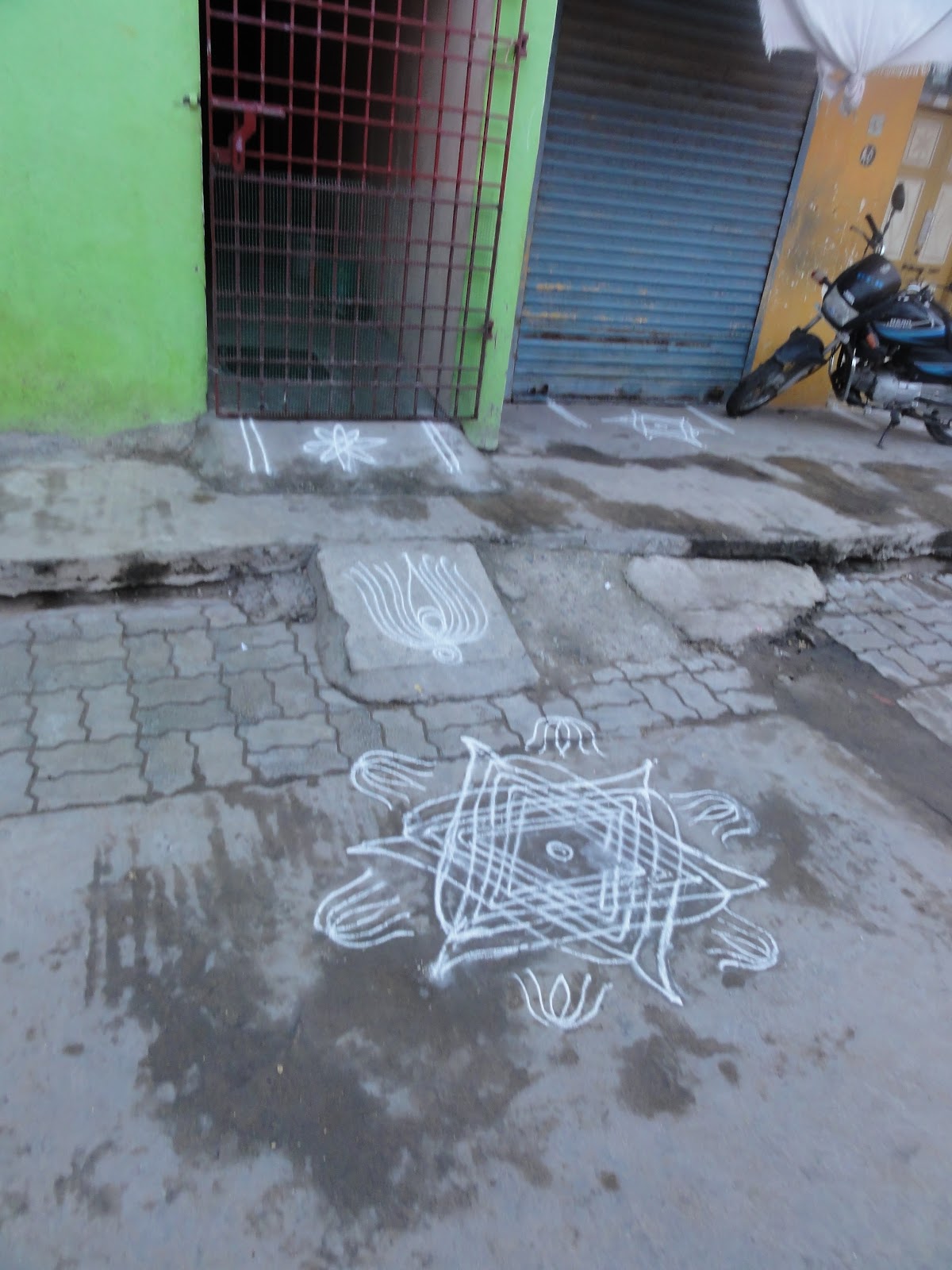
On Friday, October 23rd we got up at 5:30 to take a leisurely walk through Mamallapuram to Krishna's Butterball and Baghiratha's Penance.  In the neighborhoods through which we passed, the women were sweeping dirt and trash out of their houses into the street, after which they drew an intricate white, curlicued pattern, with rice flour or chalk powder, in the street out front.  We watched as one woman did this, interrupted when a neighbor's calf, full of youthful exuberance, galloped across it.  She patiently repaired and finished the design, and then the house was ready for the day's activities, beginning with cooking her husband's breakfast.  Sudha said that there was no set design--each day, each woman drew what she felt like drawing: there was a subtle competition with her neighbors.

Eventually, we came to Krishna's Butterball, a huge stone balanced precariously on a hillside.  Sudha told us that his last tour group had rolled it up the hill, so he expected us to roll it back down, but we weren't able to do that.  Nearby were some small temples that had been carved out of gigantic boulders.  Finally, we came to Baghiratha's Penance, a huge, elaborate frieze carved into a cliff, illustrating the story of how the sage Baghiratha had undergone an extreme ascetic discipline of fasting and standing on one leg, in order to win Shiva's assistance in bringing the river Ganges down from heaven.  A cleft in the cliff represented the Ganges itself, and in ancient times (all of Mamallapuram's monuments date from the 7th century A.D.), water would be poured down that cleft, to imitate the river.  The details of gods, people and animals, including a herd of elephants, are amazing.

After breakfast, we visited the Shore Temple, which has been sitting by the sea (at first on an island) in wind, rain and tsunami, for nearly fourteen centuries.  Then we visited the Five Rathas, another spectacular group of temples carved out of neighboring rock outcroppings, no two of them alike in style.  Everywhere there were men, selling postcards and little carvings, and gypsy women and girls, selling necklaces.

Then we went on down the coast to Pondicherry, which had been a French colony until 1954 and retains a French flavor (the policemen wear round flat-top caps (kepis), like French police.  After lunch and a rest, we went for a walk from the Sri Aurobindo ashram, which appears to own half the property in town, to a temple to Ganesha, the elephant-headed god. In front of the temple was a real, live elephant, named Lakshmi, who, if you held out a twenty-rupee note, would take it with her trunk, hand it to her master, then lay her trunk on your head, as a blessing.  We all did this, with cash supplied by Sudha from the trip "slush fund."

We finished the evening walking the Promenade along the Bay of Bengal waterfront past a monument to Gandhi, with a huge statue, all the way to the end.

Thursday, October 22, 2015

Kanchipuram

On Thursday, October 22, we went on an optional excursion to the pilgrimage town of Kanchipuram, two hours inland from Mamallapuram.  During the Pallava Empire, which ruled Tamil Nadu from the sixth to ninth centuries A.D., Kanchipuram was their capital and Mamallapuram was their principal port. We visited two ancient temples dedicated to Shiva: Ekambareshwara and Kallasanatha.  While the latter has more interesting architecture--elaborate sandstone construction, with many, many niches, friezes and statues, the former is more of a working temple, with crowds of worshippers.  We saw part of a ceremony where a couple, who had raised their children and sent them off into the world, were, in return, given an elaborate blessing ceremony, to honor and reaffirm their marriage.  A group of people from Mumbai insisted on having their pictures taken with us.  A Brahmin priest of the goddess Kali, gave us individual blessings from the goddess, putting red dots on our foreheads and giving the women small roses that had been offered to Kali.

We met a bride and groom, age 28, who had met at work and talked their parents into approving their marriage, although they were of different castes.

We stopped at the house of a family of silk weavers and saw their beautiful work, then Mary Joy shopped at the neighborhood silk cooperative.  Silk weaving on jacquard looms, as in nineteenth-century Lyon, is very common in Kanchipuram and the surrounding villages.

On the way back we visited a family of outcastes, squatting on public land outside a village, living in a collection of thatch huts.  They had electricity, but water was available at a nearby pump for only one hour a day.  The state had given them a TV and satellite dish, but in order to watch it they would have to subscribe to the satellite service, which was owned by the brother of the politician who had passed the law giving them the TV and dish.  They were very poor and shunned by their neighbors, except when higher caste men would come around looking to rape their girls, which was a reason they gave for marrying those girls off at at puberty, age 10 or 12.  One teenage girl had so far avoided pressure to marry, was still in school and told us that she wanted to be a doctor.  We encouraged her to keep on that path.


Wednesday, October 21, 2015

Chennai

Some highlights of our tour of the city of Chennai, which has a population of ten million:
We did a lot of walking around, just seeing how the people live.  The festival of Navratri is going on, celebrating the goddess Durga, who  is one of the consorts of Shiva.  Today, people had their work tools blessed.  The tuk-tuk (three-wheeled mini-cab) drivers decorated their vehicles with marigold garlands, plantain boughs, strands of rope and colored paste, and put lemons under the wheels to be crushed.  Sudha and our driver, Vijay, had the same done with our bus, and a priest performed a blessing ceremony over the bus and us.

A family was having the hair of its three very young children shaved off with a straight razor, in order to sacrifice it to the god of a nearby temple.  We walked through a noisy street-chaos--cars, trucks, buses, tuk-tuks, pedal-rickshaws, overloaded carts pulled by oxen or bare-footed men.  People insisted on having their picture taken.  One elderly pedicab driver posed sideways on his bike and fell off backwards, apparently unhurt (Sudha told us that he had apparently been drinking a little too much, in honor of the festival).

We took a wild tuk-tuk ride to the Basilica of St. Thomas.  We have now been to all three of the churches claiming to be, as a sign there proudly boasted, the burial site of one of the twelve apostles of Jesus (St. Peter's in Rome, Santiago de Compostela in Spain, and St. Thomas in Chennai).

We are now at a fancy Radisson resort in Mahabalipuram, down the Bay of Bengal coast from Chennai.


Tuesday, October 20, 2015

India.

 Long day: a short flight to Chicago, followed by 12 3/4 hours to Abu Dhabi (on Etihad Airlines), followed by three-and-a-half hours on Etihad to Chennai (formerly known as Madras), along with a large group of Indian Muslims returning from their pilgrimage to Mecca: there was some trouble sorting out their seating.

We've met our trip leader, Sudha, and four of the other seven people on the tour (two male, seven female, altogether). They all seem very nice, and the bus is air-conditioned.

Thursday, September 3, 2015

Peacock Island, Copenhagen, Home and What's Next


After breakfast on Monday, August 3rd, Marika drove us back to Wannsee, where we parked in the woods near the Church of Sts. Peter and Paul (not the Catholic one in Potsdam, but a small, Protestant chapel overlooking the Havel River).  We had seen this pretty little church from the lake cruise on Saturday.  After looking around inside, we walked down to the little ferry that crosses a narrow part of the Havel to the Pfaueninsel (Peacock Island). 


The island was used by nineteenth-century Prussian kings as a sort of summer playground, with a fake “ruined” castle (of wood painted to look like stone)
a garden, a dairy designed to look like a ruined abbey—there is now a small herd of water buffalo on the island—and a menagerie.  The last was disbanded when the Berlin Zoo opened, but peacocks remain, wandering around the island. 


We spent several hours wandering around, seeing what is to be seen—Marika had never been there.  We stopped for a snack at an outdoor café, but our choice in cakes was limited by the fact that, for instance, the pear-cake was covered with yellow jackets, burying their heads in the fruit on top.  We got a slice of something else.

We left the island and went back into the city, hoping to get an early dinner at Engelbecken, one of our favorite restaurants, but it wasn’t open yet, so we ate instead at a cafe across the street.

Now it was time to go, so we piled into Marika’s car and she drove us out to Schoenefeld Airport.  We checked our luggage with EasyJet again, then said goodbye to Marika and went through security, which was not as tough as the very strict security at Lyon St.-Exupery.  That had been more complicated than any we’d had in the U.S.

The 8:15 p.m. flight to Copenhagen, after another very long taxi, to the takeoff point, was uneventful.  We arrived on time (9:25) or earlier, checked in, on a machine, for our flights back home the next day, then took the Metro again to Kongens Nytorv.  We walked from there a few blocks to our hotel, Wakeup Copenhagen Borgergade.  This is a rather odd hotel--simple, ultra-Danish-Modern in design, with very small rooms that waste no space and are aimed at the 21st-century traveler.  There is free WiFi, of course, but no room phone—doesn’t everyone have a cell phone, so why would they need a room phone?

We were up the next morning before 4 a.m., checked out, caught the Metro (which runs all night, on a reduced schedule) to the airport, and got into a very long security line.  It moved pretty quickly, though.

We left on the 8:20 Delta flight to JFK, arriving at 10:59.  They served breakfast on the plane (I forget what).  Not having traveled outside the country for three years, we were surprised that I didn’t have to spend time on the plane filling out a customs form.  We discovered on arrival at passport control that the customs and immigration process has largely been automated.  We were told to go to any one of dozens of machines, as long as it was showing a green light.  There I swiped my passport, posed for a picture, answered questions about how much and what we’d brought back and whether we’d petted cows, etc.  Then a white slip with my picture and writing on it was printed out.  Mary Joy then swiped her passport and posed for her picture and got her printed slip.  We were then directed into line to wait for someone to look at and stamp our slips.

Next we went past the baggage carrousels (we hadn’t checked our bags on this flight) to the customs desk, and we were through. 

We had to go through security again, then find our gate and wait for our 4:15 flight home.  We had lunch at Panda Express.

We arrived at MSP before the scheduled 6:42 arrival time and took a taxi home

Our next trip, in a few months, will be to India.  I have decided that I will no longer be blogging trips in the same blow-by-blow detail as in the past.  I used to be able to relax on trips, using travel time to read: I read Jared Diamond’s Guns, Germs and Steel in 2000 on trains in Germany, Switzerland and Austria.  I read most of Harry Potter and the Order of the Phoenix in Spanish on a cruise boat on the Yangtze River.  Blogging the way I have been doing it is very labor- and time-intensive, and, quite frankly, too much work.

I intend to keep this up, but more as a notebook for impressions and anecdotes, no longer as a detailed description of how we went about getting from Point A to Point B.

Photos

I've gone back and filled in with photos.  There's only one post to go for this trip!

Wednesday, September 2, 2015

Charlottenburg Palace Gardens and a Cruise on the Spree


We slept in a little on Sunday, August 2nd, then went to brunch with Marika, her brother, sister-in-law, nieces and friends Gisela and Ulla on the terrace in front of a café on Stuttgarter Platz.  It was another perfect day, like the day before, and it was very pleasant to sit in the sunshine with good company and good food.

Afterwards, we said goodbye to the others, and now we had Marika to ourselves for the next two days.  Her suggestion was to visit the gardens at the Charlottenburg Palace, near which we could board a cruise boat for a trip on the River Spree through the center of Berlin.

We didn’t actually enter the large baroque palace, built in the 17th and 18th centuries, but we visited the gift shop and then went around to the very extensive gardens in back. 
After some time there, we hurried a few blocks, to the banks of the Spree, where we boarded a cruise boat to go up the river.  A man near the bow with a microphone narrated what we were seeing on either side, first in German, then in English, without notes. 
As the Spree is the river on whose banks Berlin was born, this itinerary took us into the very heart of the city.  We passed the Belvedere palace, home of the President; then the offices of the Chancellor, Angela Merkel; then modern buildings holding offices for the Bundestag, the German parliament; then the Reichstag Building,
burned in 1933, but restored, with a modernistic glass dome, since German reunification (we had had a tour there in 2011); then past the Museum Island, with the Pergamon Museum and the German Cathedral (we had visited them in 2000); then the Nikolai Quarter, which we had wandered in 2011), with the Television Tower’s tall, bulbous East German pride behind and above it. 
The ride ended at the Jannowitz Bridge, next to which we sat while we planned our next move.


We decided to have dinner at a restaurant that we’d passed on the tour, the Restaurant-Boat Patio.  This was a barge, floating in the river near the Bellevue Palace, that had been turned into a restaurant. 
We took the S-Bahn to the Bellevue stop and crossed the river.  I don’t remember exactly what we are, but I remember that it wasn’t bad, yet the portions were small, considering the price.

By then it was getting dark.  We went back to Marika’s neighborhood and checked to see if the Radio Tower was open, but it appeared to be under repair. 
And so, to bed.