Wednesday, February 16, 2011
Next
We are heading for Phoenix in March and Hilton Head in May. After that, who knows? Maybe even India.

Wednesday, December 29, 2010
Why Do We Live Here?

Unfortunately, we aren't headed anywhere warm in the near future. With three feet of snow in December, our backyard St. Francis statue is looking forward to the return of Brother Sun.
Tuesday, October 26, 2010
A Cooking Class, a Concert and Home
Monday morning we could sleep in some, since we were skipping out on the conference activities (either touring Monte Alban, which we had done in 2002, or playing the organs at La Soledad or the cathedral). Instead, we took a cooking class, at Casa Crespo, which had good reviews on Tripadvisor but, most of all, had classes on any day that anyone wanted to sign up for one, while the other cooking classes (such as Susana Trilling’s or Pilar Cabrera’s) weren’t taught on Mondays and had a set minimum number of students before a class would be held.
We arrived a few minutes late, because we relied on the address in Lonely Planet, rather than that in Chef Oscar’s e-mail. It appears that in the not-too-distant past he has moved his restaurant to a location closer to the tourist crowds, and Lonely Planet hadn’t yet gotten word of that. There was one other student, a young Australian doctor named Caroline. She was spending six months wandering around the Americas (her brother lives in Peru) before starting her specialization work in obstetrics and gynecology.
Oscar first gave us some options for what we would make. We eventually agreed on chicken in mole negro (Caroline especially wanted to do that, though Mary Joy thought it would be nice to try something different after having had that so often on this trip), squash flower soup, plantain fritters and rose-flavored ice cream.
Then he took us to the neighborhood market, where he picked up the ingredients and he showed us various fruits, vegetables, etc., that we wouldn’t find in Minnesota, or even Melbourne, Australia. When we got back to Casa Crespo, we were given white aprons and put right to work.
It was interesting, and Mary Joy said that the mole we made was the best she had ever tasted, though, to her everlasting shame, the tortilla she made ended up a mess. On the whole, it was a good experience, ending in a nice meal. Some of the few negative reviews on Tripadvisor complained that Oscar was detached, distant and distracted by constant cell-phone interruptions. This was largely true of our class. Once he was on the phone while we were frying mole ingredients in oil, so I started to cook the squash seeds, but as soon as he noticed that, he called his assistant in to stop it, while continuing his phone conversation—the seeds should be dry-roasted, or they’ll take on too much oil. He didn’t eat with us, but said goodbye to us while we were eating, because he had to be somewhere else.
That afternoon, Mary Joy got in her shopping, doing most of it at the women's cooperative store, MORA, though she also got some alebrijes at the Labastida street market, from the son of sculptor Fabiano Lopez, of the alebrije-making village, San Martin Tilcajete. A taxi driver was there with young Sr. Lopez, and laughed at my being loaded down with all Mary Joy's loot. "Do you know what Mexican men are like?" he joked. "Son como burros," I replied. They're like burros. He laughed. "Es lo mismo en los Estados Unidos," I added. It's the same in the United States.
We went back to the B&B for a short rest, then went down to the Cathedral for that evening’s
 concert. Since we were early, we wandered
 through the Alameda and Zocolo. The amount of activity—vendors’ stalls, restaurants, clowns, shoeshine men, families making their evening paseo, even a marimba band, with couples dancing to its music—was almost exhausting. We went into the Cathedral, where we were met by a stunning sight—all the many tall columns in the church had been completely covered with lily bouquets, from floor to high ceiling. It apparently had to do with some festival the day before.
After a wonderful concert by Cristina Garcia Banegas, we said goodbye to all the people we had met at the conference. The next day, most of them would go on an overnight trip even farther into the Mixteca Alta than we had gone on Saturday.
We just barely managed to get to La Biznaga restaurant just before ten, in time to order a light meal of quesadillas and a salad. The restaurant has a reputation as a hip, imaginative, nouvelle cuisine place. It looked and sounded like the sort of place where young, sophisticated people would hang out, to see and be seen. Jazz or alternative folk music was playing in the background and the waiters had tee-shirts and spoke good American English. The menu was in large letters on a huge green slate hung on one wall. Our food was very good.
This morning (Tuesday) we were up by six, and out to the taxi before six thirty. We had a little problem at the airport, in that the stamped tin Christmas ornaments that Mary Joy had bought as presents could not be carried into the cabin (possible weapons). So she had to rearrange things and gate-check her big backpack.
Once in Houston, the security line was very long, so it took us about 45 minutes to get through. We got some Chinese food from Panda Express. We had eaten there in the E terminal food court in 2005, when we had gone to Morelia, Mexico with our friend Ellen (there was, by the way, an organist from Morelia at the conference). Now we hurried to take this food over to Terminal B. However, two workers on the interterminal train line had been hit by a train, so the whole train system was shut down. We had to backtrack some in order to stand in line for a bus to Terminal B. We boarded our plane immediately, and only had to wait a short while for other passengers before taking off.
Weather in the Twin Cities wasn’t good. High winds had apparently closed several runways, so we circled for more than half an hour before being allowed to land. But now we’re home.
The trip was fun. We liked Oaxaca very much, met some enjoyable and interesting people, heard some good music, were honored in a wonderful village fiesta and did some Mexican cooking. We did very few of the required Oaxaca tourist things, but we had done all of those (except eat chapulines—fried grasshoppers) eight years ago. Our bed and breakfast (Oaxaca Ollin) was very nice and well located. The owners (Jon McKinley and his wife, Judith Reyes) and staff were pleasant and helpful. The breakfasts were very good. There was even a swimming pool, which, unfortunately, we never had time to use. The standard Mexican things that take some getting used to are the need to use bottled or purified water for any drinking or even brushing of teeth, and the fact that most Mexican plumbing, like most Greek plumbing, can’t take toilet paper, so there are bins next to the toilet, sometimes covered and sometimes not. But we like Mexico a lot, nonetheless.
We arrived a few minutes late, because we relied on the address in Lonely Planet, rather than that in Chef Oscar’s e-mail. It appears that in the not-too-distant past he has moved his restaurant to a location closer to the tourist crowds, and Lonely Planet hadn’t yet gotten word of that. There was one other student, a young Australian doctor named Caroline. She was spending six months wandering around the Americas (her brother lives in Peru) before starting her specialization work in obstetrics and gynecology.
Oscar first gave us some options for what we would make. We eventually agreed on chicken in mole negro (Caroline especially wanted to do that, though Mary Joy thought it would be nice to try something different after having had that so often on this trip), squash flower soup, plantain fritters and rose-flavored ice cream.
Then he took us to the neighborhood market,
 where he picked up the ingredients and he showed us various fruits, vegetables, etc., that we wouldn’t find in Minnesota, or even Melbourne, Australia. When we got back to Casa Crespo, we were given white aprons and put right to work.
It was interesting, and Mary Joy said that the mole we made was the best she had ever tasted, though, to her everlasting shame, the tortilla she made ended up a mess. On the whole, it was a good experience, ending in a nice meal. Some of the few negative reviews on Tripadvisor complained that Oscar was detached, distant and distracted by constant cell-phone interruptions. This was largely true of our class. Once he was on the phone while we were frying mole ingredients in oil, so I started to cook the squash seeds, but as soon as he noticed that, he called his assistant in to stop it, while continuing his phone conversation—the seeds should be dry-roasted, or they’ll take on too much oil. He didn’t eat with us, but said goodbye to us while we were eating, because he had to be somewhere else.
That afternoon, Mary Joy got in her shopping, doing most of it at the women's cooperative store, MORA, though she also got some alebrijes at the Labastida street market, from the son of sculptor Fabiano Lopez, of the alebrije-making village, San Martin Tilcajete. A taxi driver was there with young Sr. Lopez, and laughed at my being loaded down with all Mary Joy's loot. "Do you know what Mexican men are like?" he joked. "Son como burros," I replied. They're like burros. He laughed. "Es lo mismo en los Estados Unidos," I added. It's the same in the United States.
We went back to the B&B for a short rest,
 then went down to the Cathedral for that evening’s
 concert. Since we were early, we wandered
 through the Alameda and Zocolo. The amount of activity—vendors’ stalls, restaurants, clowns, shoeshine men, families making their evening paseo, even a marimba band, with couples dancing to its music—was almost exhausting. We went into the Cathedral, where we were met by a stunning sight—all the many tall columns in the church had been completely covered with lily bouquets, from floor to high ceiling. It apparently had to do with some festival the day before.
After a wonderful concert by Cristina Garcia Banegas, we said goodbye to all the people we had met at the conference. The next day, most of them would go on an overnight trip even farther into the Mixteca Alta than we had gone on Saturday.
We just barely managed to get to La Biznaga restaurant just before ten, in time to order a light
 meal of quesadillas and a salad. The restaurant has a reputation as a hip, imaginative, nouvelle cuisine place. It looked and sounded like the sort of place where young, sophisticated people would hang out, to see and be seen. Jazz or alternative folk music was playing in the background and the waiters had tee-shirts and spoke good American English. The menu was in large letters on a huge green slate hung on one wall. Our food was very good.
This morning (Tuesday) we were up by six, and out to the taxi before six thirty. We had a little problem at the airport, in that the stamped tin Christmas ornaments that Mary Joy had bought as presents could not be carried into the cabin (possible weapons). So she had to rearrange things and gate-check her big backpack.
Once in Houston, the security line was very long, so it took us about 45 minutes to get through. We got some Chinese food from Panda Express. We had eaten there in the E terminal food court in 2005, when we had gone to Morelia, Mexico with our friend Ellen (there was, by the way, an organist from Morelia at the conference). Now we hurried to take this food over to Terminal B. However, two workers on the interterminal train line had been hit by a train, so the whole train system was shut down. We had to backtrack some in order to stand in line for a bus to Terminal B. We boarded our plane immediately, and only had to wait a short while for other passengers before taking off.
Weather in the Twin Cities wasn’t good. High winds had apparently closed several runways, so we circled for more than half an hour before being allowed to land. But now we’re home.
The trip was fun. We liked Oaxaca very much, met some enjoyable and interesting people, heard some good music, were honored in a wonderful village fiesta and did some Mexican cooking. We did very few of the required Oaxaca tourist things, but we had done all of those (except eat chapulines—fried grasshoppers) eight years ago.
 Our bed and breakfast (Oaxaca Ollin) was very nice and well located. The owners (Jon McKinley and his wife, Judith Reyes) and staff were pleasant and helpful. The breakfasts were very good. There was even a swimming pool, which, unfortunately, we never had time to use. The standard Mexican things that take some getting used to are the need to use bottled or purified water for any drinking or even brushing of teeth, and the fact that most Mexican plumbing, like most Greek plumbing, can’t take toilet paper, so there are bins next to the toilet, sometimes covered and sometimes not. But we like Mexico a lot, nonetheless.
Lost in Tlacolula
One thing about Mexico is that apparently anyone can use fireworks at any time. The owner of our B&B (Oaxaca Ollin) said that there is always some neighborhood festival going on, and with that you get rockets, all night and all day. Part of our greeting in Zautla was the shooting off of a rocket every few minutes.
On Saturday night there was loud music all night, until 6:30 in the morning. It appeared to be coming from the Jardin Etnobotanico. There was a wedding there Saturday evening. We had been told that one of the reasons that the state of Oaxaca had taken over the garden was to be able to rent it to rich people for weddings, quinceaneras, etc., at ten thousand dollars a pop. None of this money goes back to the Garden.

Sunday (October 24th), we got up early and went to the 7:00 mass at Santo Domingo. In colonial times, the friary there (now the terrific regional museum and cultural center) was the headquarters for the Dominican order in the whole region. The church has been restored to its full gold-leaf covered glory—it is jaw-droppingly magnificent.
Breakfast was some wonderful tamales (with chicken in a slightly sweet sauce) that had been bought at the market, since the cook had Sunday off.
Our first stop was only five minutes away from the Institute’s headquarters. San Matias Church is in the Oaxaca neighborhood of Jalatlaco, originally a separate village, where the Spanish had settled their Tlaxcalan Indian allies. The organ there would be the next one to be restored, if and when funds can be found. From there, we went north to Huayapam, with another impressive
 church and a very small unrestored organ in a side chapel. The women of the parish had made tejate, a drink with a lot of different ingredients that I don’t remember. It was a milky
 light brown and I think tiny amaranth seeds were floating on the top. When we had asked our American B&B owner about its taste, earlier that morning, he had though a moment then said that it tastes “dusty.” It’s not bad, though the seeds give it the sort of taste and consistency that might evoke the description “dusty.”

We went on to one of the region’s best known tourist attractions, the Tule tree. It’s a two-thousand-year-old Mexican cypress that, as far as bulk is concerned, may be the largest living thing on earth. A small ten-year-old boy with a mirror went around with us, reflecting light on features of the tree and explaining in a loud, theatrical voice what these features were called (a lion, a waterfall, a squirrel, someone’s rear end, etc.).
Next stop was Tlacolula, which is famous for its huge Sunday market, which we had to pass through in order to get to the church. The market was larger than usual, due to some fiesta. There were so many people crowded into a large but inadequate space that I felt a little claustrophobic. Eventually, we collected at the church. It is large (as usual) but generally undistinguished,
 except for a large baroque pilgrimage chapel, recently restored. There are two non-functioning organs--a tiny but ornate table organ in a storage room and a much bigger one in the choir loft.
 Some of us went up to the belfry to look at the bells and the clock mechanism and the view out over the market.

Cicely collected us and led us out through the maze of the market, with hordes of people pressing in both directions. Even though she knew the market well, she at first took a wrong turn, confused by some carnival rides that took up room on the side streets. She had to double back in another direction to find the right way to the vans. I was in sight of her, but due to the press of the crowds, the people behind me got strung out and lost her from view. Some of them caught sight of me and went the right way, but a few others, including Mary Joy, didn’t. I stopped and waited for people, waving them on, until no one else of our group appeared. No Mary Joy. I turned to follow Cicely and the others, but they were now out of sight, and I wasn’t sure which way they had gone. I first went right, but after going on about a hundred yards, with no vans in sight, I turned around and went left, and eventually found the group. But Mary Joy wasn’t there. However, it turned out that she was with a couple who had a cell phone, so contact was made and the whole group was eventually reunited.
However, in the meantime, a couple of police tow-trucks had parked behind us, blocking all the vans from exiting, and the policemen had wandered off. Eventually, Cicely had to go to the police office and find someone who could get the trucks moved. We ended up leaving Tlacolula at 3:00, one-and-a-half hours behind schedule.
We made our (late) lunch stop at Restaurant Donaji in Mitla. Again, squash flower soup and chicken in mole negro. Also, ice cream for dessert. Good.

From Mitla we went to San Dionisio Ocotepec to see another unrestored organ.
Finally, we went to Tlacochahuaya again and Guy Bovet gave a terrific performance there. As an encore, he had the son of the sacristan come up to the choir loft with his trombone. Beforehand, Bovet had asked him to play a tune on the trombone. Bovet listened to it, and at the concert had him play it again, while Bovet improvised wonderfully on it.
When we got back, it was around nine o’clock. We went to Café Los Cuiles, where we had tlayudas and fruit juice. Very good.
On Saturday night there was loud music all night, until 6:30 in the morning. It appeared to be coming from the Jardin Etnobotanico. There was a wedding there Saturday evening. We had been told that one of the reasons that the state of Oaxaca had taken over the garden was to be able to rent it to rich people for weddings, quinceaneras, etc., at ten thousand dollars a pop. None of this money goes back to the Garden.

Sunday (October 24th), we got up early and went to the 7:00 mass at Santo Domingo. In colonial times, the friary there (now the terrific regional museum and cultural center) was the headquarters for the Dominican order in the whole region. The church has been restored to its full gold-leaf covered glory—it is jaw-droppingly magnificent.
Breakfast was some wonderful tamales (with chicken in a slightly sweet sauce) that had been bought at the market, since the cook had Sunday off.
Our first stop was only five minutes away from the Institute’s headquarters. San Matias Church is in the Oaxaca neighborhood of Jalatlaco, originally a separate village, where the Spanish had settled their Tlaxcalan Indian allies.
 The organ there would be the next one to be restored, if and when funds can be found. From there, we went north to Huayapam, with another impressive
 church and a very small unrestored organ in a side chapel. The women of the parish had made tejate, a drink with a lot of different ingredients that I don’t remember. It was a milky
 light brown and I think tiny amaranth seeds were floating on the top. When we had asked our American B&B owner about its taste, earlier that morning, he had though a moment then said that it tastes “dusty.” It’s not bad, though the seeds give it the sort of taste and consistency that might evoke the description “dusty.”
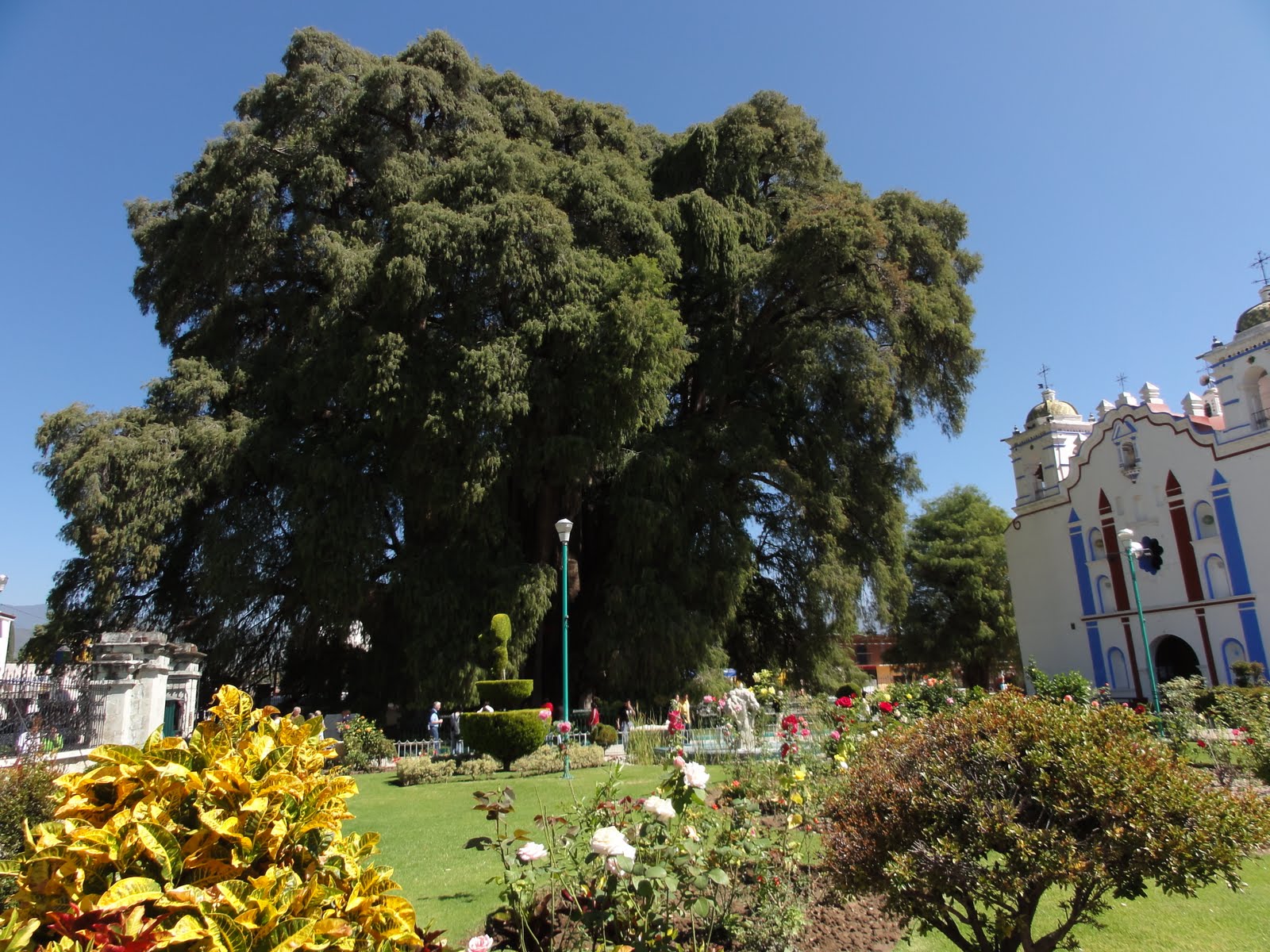
We went on to one of the region’s best known tourist attractions, the Tule tree. It’s a two-thousand-year-old Mexican cypress that, as far as bulk is concerned, may be the largest living thing on earth. A small ten-year-old boy with a mirror went around with us, reflecting light on features of the tree and explaining in a loud, theatrical voice what these features were called (a lion, a waterfall, a squirrel, someone’s rear end, etc.).
Next stop was Tlacolula, which is famous for its huge Sunday market, which we had to pass through in order to get to the church. The market was larger than usual, due to some fiesta.
 There were so many people crowded into a large but inadequate space that I felt a little claustrophobic. Eventually, we collected at the church. It is large (as usual) but generally undistinguished,
 except for a large baroque pilgrimage chapel, recently restored. There are two non-functioning organs--a tiny but ornate table organ in a storage room and a much bigger one in the choir loft.
 Some of us went up to the belfry to look at the bells and the clock mechanism and the view out over the market.

Cicely collected us and led us out through the maze of the market, with hordes of people pressing in both directions. Even though she knew the market well, she at first took a wrong turn, confused by some carnival rides that took up room on the side streets. She had to double back in another direction to find the right way to the vans. I was in sight of her, but due to the press of the crowds, the people behind me got strung out and lost her from view. Some of them caught sight of me and went the right way, but a few others, including Mary Joy, didn’t. I stopped and waited for people, waving them on, until no one else of our group appeared. No Mary Joy. I turned to follow Cicely and the others, but they were now out of sight, and I wasn’t sure which way they had gone. I first went right, but after going on about a hundred yards, with no vans in sight, I turned around and went left, and eventually found the group. But Mary Joy wasn’t there. However, it turned out that she was with a couple who had a cell phone, so contact was made and the whole group was eventually reunited.
However, in the meantime, a couple of police tow-trucks had parked behind us, blocking all the vans from exiting, and the policemen had wandered off. Eventually, Cicely had to go to the police office and find someone who could get the trucks moved. We ended up leaving Tlacolula at 3:00, one-and-a-half hours behind schedule.
We made our (late) lunch stop at Restaurant Donaji in Mitla. Again, squash flower soup and chicken in mole negro. Also, ice cream for dessert. Good.

From Mitla we went to San Dionisio Ocotepec to see another unrestored organ.
Finally, we went to Tlacochahuaya again and Guy Bovet gave a terrific performance there. As an encore, he had the son of the sacristan come up to the choir loft with his trombone. Beforehand, Bovet had asked him to play a tune on the trombone. Bovet listened to it, and at the concert had him play it again, while Bovet improvised wonderfully on it.
When we got back, it was around nine o’clock. We went to Café Los Cuiles, where we had tlayudas and fruit juice. Very good.
Sunday, October 24, 2010
Tamazulapan, Yanhuitlan and Zautla

Saturday, we divided up into five vans and headed northwest. After several hours we arrived at the village of Tamazulapan, a market town on the Pan-American Highway. It has a church that is much larger and more splendid than anyone would expect. There is a small, restored table organ there, so we had a concert, with Guy Bovet and Barbara Owen playing short baroque or baroque-style pieces on the organ, interspersed  with pieces played on the marimba and guitar by two very good young Mexican musicians,
 Gabriela Perez Diaz (22) and Vladimir Ibarra (24). A pair of local students played at the end. Afterwards, their mothers presented us with a lunch of sandwiches.
Then we went on to the huge Church of Santo Domingo in the village of Yanhuitlan (population 830). It is being restored and not currently in use as a parish church, but the large organ is beautiful and sounds very nice too, as a concert with organ (played by the Uruguayan organist Cristina Garcia Banegas, whom we had heard in Minneapolis at the 2008 American Guild of Organists Convention) and choir (again, the Capilla Virreinal de la Nueva Espana)
From there we went to Zautla. Since there is no exit on the toll road at Zautla, a Federal Highways truck had pulled off the road and the men in it flagged down our vans, having removed the blockage that prevented exit directly onto a dirt shortcut leading to the highway to Zautla. The Mexican government is apparently willing to waive standard highway procedures in order to advance the national cultural heritage.

In front of the church of San Andreas our group was met by a brass band, a pair of big, dancing papier mache figures and the older women of the village, who offered us bougainvillea leis, bunches of green leaves (which, I think, is something related to a hangover cure given to party guests in advance) and little plastic cups of mezcal. Then the women led many of our group in a dance. Mary Joy danced very well.

We then went around in back of the church, where tables were set up and we had a terrific meal, at the center of which was pork in a sauce called pipillan (I’m not sure exactly what was in it, but it was very good, though not picante).
There was also more mezcal. I had to ask the ladies not to give Mary Joy any more or she'd be dancing on the table.
Afterwards, we went into the church, where Cristina Garcia Banegas played mostly baroque pieces on the restored medium-sized table organ, and the young Mexican percussionist and guitarist that we had heard earlier played very modern pieces on guitar and multiple percussion instruments.
We got back to our room a little before ten and got to bed around eleven. I'll post more pictures from Saturday tomorrow.
 with pieces played on the marimba and guitar by two very good young Mexican musicians,
 Gabriela Perez Diaz (22) and Vladimir Ibarra (24). A pair of local students played at the end. Afterwards, their mothers presented us with a lunch of sandwiches.
Then we went on to the huge Church of Santo Domingo in the village of Yanhuitlan (population 830). It is being restored and not currently in use as a parish church, but the large organ is
 beautiful and sounds very nice too, as a concert with organ (played by the Uruguayan organist Cristina Garcia Banegas, whom we had heard in Minneapolis at the 2008 American Guild of Organists Convention) and choir (again, the Capilla Virreinal de la Nueva Espana)
From there we went to Zautla. Since there is no exit on the toll road at Zautla, a Federal Highways truck had pulled off the road and the men in it flagged down our vans, having removed the blockage that prevented exit directly onto a dirt shortcut leading to the highway to Zautla. The Mexican government is apparently willing to waive standard highway procedures in order to advance the national cultural heritage.

In front of the church of San Andreas our group was met by a brass band, a pair of big, dancing papier mache figures and the older women of the village, who offered us bougainvillea leis, bunches of green leaves (which, I think, is something related to a hangover cure given to party guests in advance) and little plastic cups of mezcal. Then the women led many of our group in a dance. Mary Joy danced very well.

We then went around in back of the church, where tables were set up and we had a terrific meal, at the center of which was pork in a sauce called pipillan (I’m not sure exactly what was in it, but it was very good, though not picante).

There was also more mezcal. I had to ask the ladies not to give Mary Joy any more or she'd be dancing on the table.
Afterwards, we went into the church, where Cristina Garcia Banegas played mostly baroque pieces on the restored medium-sized table organ, and the young Mexican percussionist and guitarist that we had heard earlier played very modern pieces on guitar and multiple percussion instruments.
We got back to our room a little before ten and got to bed around eleven. I'll post more pictures from Saturday tomorrow.
Saturday, October 23, 2010
Expatriates
Today (Saturday, October 23rd) was a very long day, and tomorrow will be just as long. We bussed out at 8:30 and tomorrow it will be 8:45 and both days back late in the evening. Today we went west and north, to the Mixteca Alta (the High Mixteca). Sunday we head east, into the Valley of Oaxaca. Last night at the reception we met some interesting people. There is a couple from Columbus who have a house in Oaxaca and spend four months a year here. They feel very safe here—the drug wars are up on the border, and professional kidnappers wouldn’t go after gringos, who would have to have any large sums of money for a ransom transferred and exchanged, unlike rich Mexicans. In any case, Americans who live here are probably doing so because they aren’t wealthy and it's much more affordable here than in the U.S. Medical and dental care are both very good and amazingly inexpensive—an English-speaking doctor charged $40 for a house call, and nothing for follow-up. The man had a bridge replaced, very well—their regular dentist is now one in Oaxaca. I would feel a little uncomfortable about being a “rich” foreigner living in a poor country, not so much from fear as from a feeling that I would never be a genuine part of the community. We had fun today and I took a lot of pictures, but that will have to wait.
Friday, October 22, 2010
Tlacochahuaya
This morning (Friday the 22nd) we had another nice breakfast (a sort of scrambled egg covered with a red chili sauce), then caught the bus again (this time, I tagged along) to Tlacochahuaya. For such a small village, the church (San Jeronimo) is large and very beautifully decorated. People were restoring the murals inside. 

We went up the steep, narrow, circular staircase to the choir loft, where there is a very elaborately decorated one-manual organ, one of the first restored. Guy Bovet, the Swiss organist and expert on Spanish baroque organ music, conducted a master class, in Spanish and English. Some young Mexican students and Cicely Winter, the director of the institute here, played short pieces and Bovet offered critiques and suggestions.
Mary Joy first encountered Guy Bovet on his home grounds, in the beautiful old village of Romainmotier, Switzerland, where every year he runs an organ conference in the medieval abbey. In 1989, Mary Joy attended that conference, where she met her friends Marika and Bernard, from Germany (she roomed with Marika). She went back in 1991. A few years ago, Bovet was in Minneapolis to inaugurate the new organ in St. Olaf Catholic Church downtown.

After the master class (during which I wrote almost all of this post), we got back on the bus and went back to Oaxaca, to have lunch at La Olla (The Pot). We had eaten there several times, eight years ago, and liked it very much. The menu stated that the meal was saludable (healthy). We started out with a glass of what they called “lemon tea” along with a much smaller glass of mezcal, which is related to tequila, but made in a different part of Mexico, also from agave plants. It was dark and tasted like wood smoke—we liked it. First came a nice organic salad, followed by a wonderful squash-flower soup (a specialty of Oaxaca). Then we had zucchini stuffed with cheese, corn and herbs. Finally, for dessert we had a Mexican bread pudding. We're going back to La Olla before we leave!
The evening was spent first at the Francisco Burgoa Library, where there was a slide presentation on Oaxacan organs, followed by an explanation of an exhibit about organs and their use in Oaxaca over the centuries, followed by a reception, with more mezcal and appetizers, along with other Mexican drinks, non-alcoholic (a sweet, dark red, cold hybiscus flower tea and horchata, a sweet, milky almond drink). We then all walked a number of blocks to the Textile Museum, where, in an old chapel that used to belong to a convent, we heard a concert of polyphonal songs from old books that had been found in a chest next to an organ out in one of the villages (San Bartolo Yautepec). The eight singers, directed by a Peruvian, were called the Capilla Virreinal de la Nueva Espana (the Viceregal Chapel of New Spain--i.e., colonial Mexico). The music was beautiful and beautifully sung. And so to bed.


We went up the steep, narrow, circular staircase to the choir loft, where there is a very elaborately decorated one-manual organ, one of the first restored. Guy Bovet, the Swiss organist and expert on Spanish baroque organ music, conducted a master class, in Spanish and English. Some young Mexican students and
 Cicely Winter, the director of the institute here, played short pieces and Bovet offered critiques and suggestions.
Mary Joy first encountered Guy Bovet on his home grounds, in the beautiful old village of Romainmotier, Switzerland, where every year he runs an organ conference in the medieval abbey. In 1989, Mary Joy attended that conference, where she met her friends Marika and Bernard, from Germany (she roomed with Marika). She went back in 1991. A few years ago, Bovet was in Minneapolis to inaugurate the new organ in St. Olaf Catholic Church downtown.


After the master class (during which I wrote almost all of this post), we got back on the bus and went back to Oaxaca, to have lunch at La Olla (The Pot). We had eaten there several times, eight years ago, and liked it very much. The menu stated that the meal was saludable (healthy). We started out with a glass of what they called “lemon tea” along with a much smaller glass of mezcal, which is related to tequila, but made in a different part of Mexico, also from agave plants. It was dark and tasted like wood smoke—we liked it. First came a nice organic salad, followed by a wonderful squash-flower soup (a specialty of Oaxaca). Then we had zucchini stuffed with cheese, corn and herbs. Finally, for dessert we had a Mexican bread pudding. We're going back to La Olla before we leave!
The evening was spent first at the Francisco Burgoa Library, where there was a slide presentation on Oaxacan organs, followed by an explanation of an exhibit about organs and their use in Oaxaca over the centuries, followed by a reception, with more mezcal and appetizers, along with other Mexican drinks, non-alcoholic (a sweet, dark red, cold hybiscus flower tea and horchata, a sweet, milky almond drink). We then all walked a number of blocks to the Textile Museum, where, in an old chapel that used to belong to a convent, we heard a concert of polyphonal songs from old books that had been found in a chest next to an organ out in one of the villages (San Bartolo Yautepec). The eight singers, directed by a Peruvian, were called the Capilla Virreinal de la Nueva Espana (the Viceregal Chapel of New Spain--i.e., colonial Mexico). The music was beautiful and beautifully sung. And so to bed.
Subscribe to:
Posts (Atom)