Monday, October 26, 2015

A Temple, Two Workshops and an Orphanage


On Sunday, October 25th, we went to the thousand-year-old Brihadishwara temple. I forgot to bring my "temple socks" from the bus, so, like Sudha and the trip-leader-in-training, Stalin (he says that he wasn't aware of his namesake's reputation until he was grown), I went barefoot. You are not allowed to wear shoes in temples, so most tourists wear an old pair of socks that they don't mind getting dirty. Going barefoot was actually pleasant--the floors and grounds here were relatively clean. Although the temple was dedicated to Shiva, Sudha told us that the king who had had the temple built in the early eleventh century was himself devoted to another god, so there was a small shrine on the lawn, holding a statue of a boar dressed in women's clothes--one of the incarnations of Vishnu. Sudha brought us over and introduced us to the Brahmin priest, who had just spent a year in Boston, serving a Hindu community there. He was bare-chested and barefoot, wearing a topknot and the traditional kilt, the dhoti. We lined up around the enclosure and he gave each of us a blessing and the ubiquitous red dot, the bindi, in the middle of the forehead. Meanwhile, a man in yellow was blowing a conch shell on the temple steps. He then went to the Vishnu shrine and blew it there.

In front of the temple is a huge black statue of Shiva's main transport, the bull Nandi, and in a niche to the left of the door was a statue of Shiva's son, Ganesha, the elephant-headed god who someone that day told us is the most-worshipped god in India. Unlike in the temple in Kanchipuram, where we could take pictures if we paid a fee, signs everywhere proclaimed that no photography was allowed in the temple. But, as usual, once we got inside there were people flashing away at the huge, black linga stone representing Shiva. The bindi, Ganesha and the linga will be explained better in a future digression.

We got into a long, slow, single-file line, and worked our way to the front, where there were three priests, one of whom took our offering (I didn't see what it was), burned it in front of the god and brought back the ashes, which an older priest dotted on our foreheads. Behind us, a group of women was singing a hymn to Shiva, in Sanskrit, very beautifully.

As we came out of the temple, Sudha saw a group of people sitting under an arcade across the grounds, by the wall that surrounded the temple quarter. He thought that it was a couple of families arranging a marriage, and that's what it was. He introduced us to them and them to us: the prospective groom's family, the prospective bride's family, the mediator or marriage broker, and maybe the astrologer. Sudha was surprised that the couple themselves were there. The families were from separate places, twenty miles apart, and were now meeting each other for the first time. Since the family backgrounds were suitably matched and the astrological charts were harmonious, now the families were here to get a feel for each other, face to face. When our group asked them about how husbands and wives in arranged marriages managed to get along, the groom's mother (a banker) made a long (and, Mary Joy said, very eloquent--I wasn't positioned to hear) statement about the importance of family and one's place in one's society and how one needed to put love of others before one's own preferences, in order to arrive eventually at God. Later we saw the two young people, in western clothes (he had a smartphone) standing away from the others, talking, getting acquainted for the first time. Sudha said that based on their impressions of each other, either one could at this point put a stop to the whole thing. So their whole future lives could depend on this one, short conversation.

After leaving the temple, we took the bus into a wealthy neighborhood and got off. We saw a man ironing clothes by the side of a side street., using a very heavy iron with coals inside. Further down that street was a workshop where we were shown the lost-wax process of bronze-making. A wax model was made, covered with clay (the mold), the wax was melted out of a hole in the bottom of the mold, a mixture of copper, zinc and tin was melted and poured into the mold, the mold and figurine now inside were cooled for 24 hours, the mold was broken and the statue was filed and polished.

Afterwards, of course, we visited the shop. Mary Joy got a tiny Ganesha, made of metal with an enamel coating.

Later, we visited another workshop, where they were making vinas, a string instrument like a very large mandolin, but played on the floor, with a bulbous support under the neck, to keep it level. The vina is associated in Hindu iconography with Saraswati, the goddess of music. Mary Joy was in her element, learning the instrument's tuning, which she discussed with another musician on the tour, in terms above everyone else's heads. Although it is an ancient instrument, it was played every night in the musical ensemble at our hotel's restaurant.

The workshop was in back of the owner's house, and he invited us into his front parlor, where his wife played scales for us on their own vina.

At 4:30 we took a 45-minute drive out to an orphanage which is supported in part by funds from our tour company. We met the house mothers, and then we went to the assembly hall, where all the children, ages 6 to 17, were gathered, seated on the floor, girls to our left and boys to our right. Behind them were seated, in chairs, about fifty elderly persons (the orphanage has an attached home for seniors). The children were very excited to see us. After various introductions, etc., we all sang "If You're Happy and You Know It, Clap Your Hands." Then we went back and greeted the seniors. The oldest man there was 94. No one knew exactly how old the oldest woman was, because in those days no one kept track of such things.

As soon as we finished with the old people, it was time to go out and play with the kids. I was immediately kidnapped by some boys, nine, ten, eleven years old. It was frenetic chaos. I was dragged here and there, shown their schoolroom, shown a series of tiny puppies, played some sort of game involving trying to cover the other person's thumb with your own, taught them paper-scissors-rock, did my coin-disappearing trick (in this case, stone-disappearing), took pictures of them playing "monkey" (climbing a coconut palm tree), while they were trying to pronounce the name "Mike" on my big, lanyarded yellow name tag, and were saying (shouting) such English words as "photo," "belt," "monkey" and "bad boys" (some other boys who tried to horn in on their ownership of me). Meanwhile, Mary Joy was trying to do music with some girls, but they, while more focused and less awhirl with tornadic energy than the boys, had their own agenda, too. After 45 minutes, Sudha and the house mothers rescued us all, a girl and a boy named each of us, from memory, and we said a cordial goodbye and got on the bus to return to Thanjavur.

Saturday, October 24, 2015

From Pondicherry to Thanjavur

On Saturday, October 24th, we took another of Sudha's 6 a.m. "golden hour" walks, through Pondicherry's "Black Town": in colonial times, the French lived between the canal and the seaside Promenade, while the natives lived west of the canal. The main interest was the food market and the surrounding streets, where women from the villages would come to buy fish and vegetables to take back and resell.

We ended up at a coffee stand, where we had very good coffee and samosas.

This would be largely a travel day, so luggage had to be in the hall at 7:30 and the bus would leave at 8.

Next to a Shiva temple, we visited a collection of statues of what Sudha called the "fierce gods": fanged, beweaponed beings, surrounded by severed heads, set to protect the lower castes against their various oppressors, but now somewhat domesticated and residing next to the brahminical temple.

Then, out in the country, we visited a village of Untouchables, living in thatch-roofed huts. It was named Allkondanatam. The children, who were home from school because it was a holiday, were very excited to see us. Just before we left, Mary Joy had them singing "I love to sing!" At the very end, they asked her for her autograph!

After we got to our hotel in Thanjavur (formerly known as Tanjore), before dinner, we were treated to a performance by two teenage girls of three classical Tamil dances. They were fully costumed and accompanied by two male singers (one of them their teacher) and a drummer. They danced very well.


Friday, October 23, 2015

Mamallapuram and Pondicherry

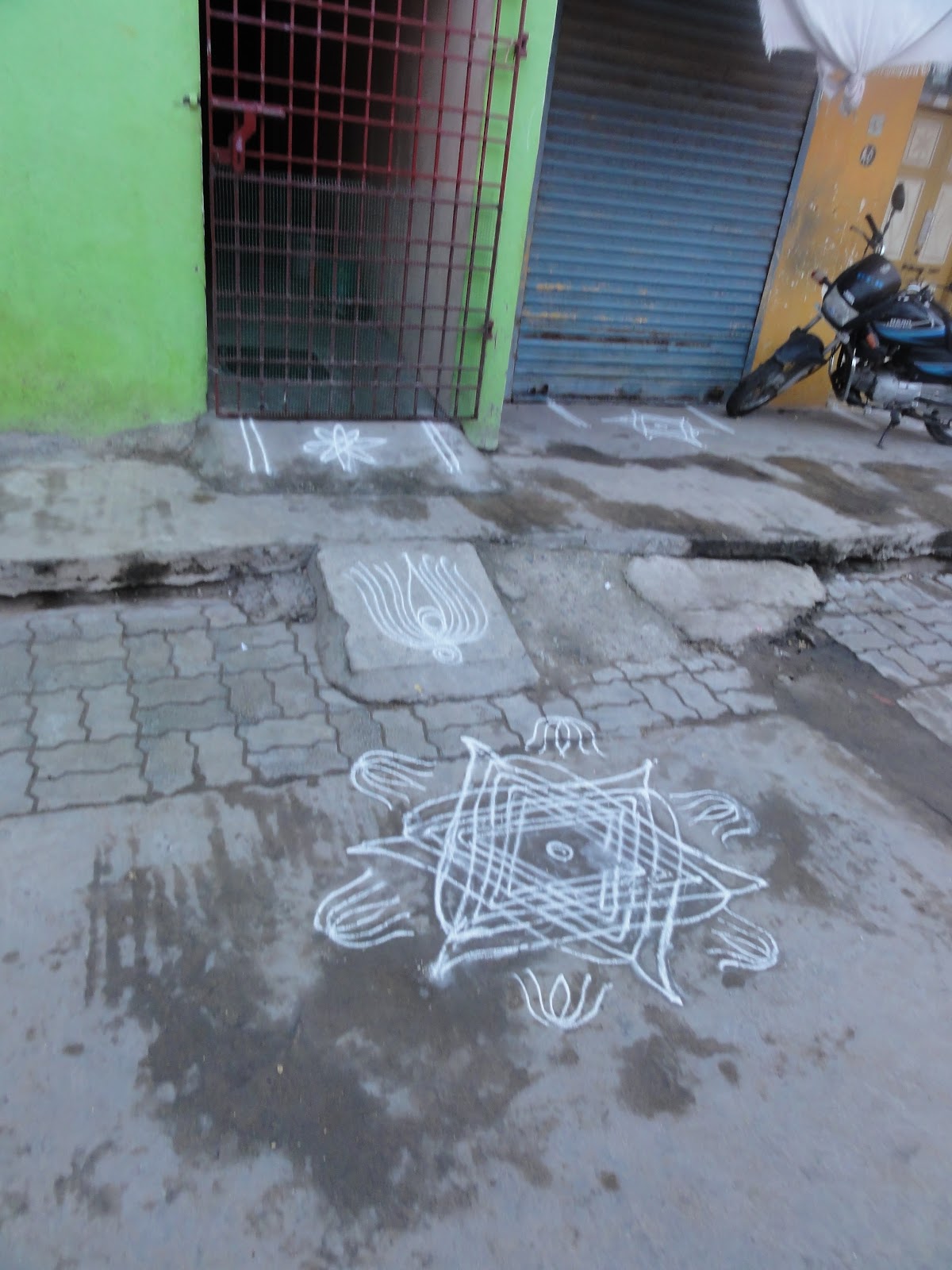
On Friday, October 23rd we got up at 5:30 to take a leisurely walk through Mamallapuram to Krishna's Butterball and Baghiratha's Penance.  In the neighborhoods through which we passed, the women were sweeping dirt and trash out of their houses into the street, after which they drew an intricate white, curlicued pattern, with rice flour or chalk powder, in the street out front.  We watched as one woman did this, interrupted when a neighbor's calf, full of youthful exuberance, galloped across it.  She patiently repaired and finished the design, and then the house was ready for the day's activities, beginning with cooking her husband's breakfast.  Sudha said that there was no set design--each day, each woman drew what she felt like drawing: there was a subtle competition with her neighbors.

Eventually, we came to Krishna's Butterball, a huge stone balanced precariously on a hillside.  Sudha told us that his last tour group had rolled it up the hill, so he expected us to roll it back down, but we weren't able to do that.  Nearby were some small temples that had been carved out of gigantic boulders.  Finally, we came to Baghiratha's Penance, a huge, elaborate frieze carved into a cliff, illustrating the story of how the sage Baghiratha had undergone an extreme ascetic discipline of fasting and standing on one leg, in order to win Shiva's assistance in bringing the river Ganges down from heaven.  A cleft in the cliff represented the Ganges itself, and in ancient times (all of Mamallapuram's monuments date from the 7th century A.D.), water would be poured down that cleft, to imitate the river.  The details of gods, people and animals, including a herd of elephants, are amazing.

After breakfast, we visited the Shore Temple, which has been sitting by the sea (at first on an island) in wind, rain and tsunami, for nearly fourteen centuries.  Then we visited the Five Rathas, another spectacular group of temples carved out of neighboring rock outcroppings, no two of them alike in style.  Everywhere there were men, selling postcards and little carvings, and gypsy women and girls, selling necklaces.

Then we went on down the coast to Pondicherry, which had been a French colony until 1954 and retains a French flavor (the policemen wear round flat-top caps (kepis), like French police.  After lunch and a rest, we went for a walk from the Sri Aurobindo ashram, which appears to own half the property in town, to a temple to Ganesha, the elephant-headed god. In front of the temple was a real, live elephant, named Lakshmi, who, if you held out a twenty-rupee note, would take it with her trunk, hand it to her master, then lay her trunk on your head, as a blessing.  We all did this, with cash supplied by Sudha from the trip "slush fund."

We finished the evening walking the Promenade along the Bay of Bengal waterfront past a monument to Gandhi, with a huge statue, all the way to the end.


Thursday, October 22, 2015

Kanchipuram

On Thursday, October 22, we went on an optional excursion to the pilgrimage town of Kanchipuram, two hours inland from Mamallapuram.  During the Pallava Empire, which ruled Tamil Nadu from the sixth to ninth centuries A.D., Kanchipuram was their capital and Mamallapuram was their principal port. We visited two ancient temples dedicated to Shiva: Ekambareshwara and Kallasanatha.  While the latter has more interesting architecture--elaborate sandstone construction, with many, many niches, friezes and statues, the former is more of a working temple, with crowds of worshippers.  We saw part of a ceremony where a couple, who had raised their children and sent them off into the world, were, in return, given an elaborate blessing ceremony, to honor and reaffirm their marriage.  A group of people from Mumbai insisted on having their pictures taken with us.  A Brahmin priest of the goddess Kali, gave us individual blessings from the goddess, putting red dots on our foreheads and giving the women small roses that had been offered to Kali.

We met a bride and groom, age 28, who had met at work and talked their parents into approving their marriage, although they were of different castes.

We stopped at the house of a family of silk weavers and saw their beautiful work, then Mary Joy shopped at the neighborhood silk cooperative.  Silk weaving on jacquard looms, as in nineteenth-century Lyon, is very common in Kanchipuram and the surrounding villages.

On the way back we visited a family of outcastes, squatting on public land outside a village, living in a collection of thatch huts.  They had electricity, but water was available at a nearby pump for only one hour a day.  The state had given them a TV and satellite dish, but in order to watch it they would have to subscribe to the satellite service, which was owned by the brother of the politician who had passed the law giving them the TV and dish.  They were very poor and shunned by their neighbors, except when higher caste men would come around looking to rape their girls, which was a reason they gave for marrying those girls off at at puberty, age 10 or 12.  One teenage girl had so far avoided pressure to marry, was still in school and told us that she wanted to be a doctor.  We encouraged her to keep on that path.