Monday, August 17, 2015

Lyon

On Friday, July 24th, we had breakfast out in a little garden terrace atrium, which served as a very nice breakfast room.    I think their was fruit, soft-boiled eggs, croissants, bread and Karine's wonderful homemade jams: apple-cinnamon and apricot-lavender--all very nice.

We walked down to the Hotel de Ville, where we caught the Metro to Bellecourt, a very large dirt square with an equestrian statue of Louis XIV in Roman dress, very similar to the somewhat later statue of Frederick V of Denmark we had seen in the square of the Amalienborg in Copenhagen.
 There are fashions in autocratic self-aggrandizement as there are in anything else, and, as in anything else, the fashions were often set by the French.  On the south side of the square is the main Lyon tourist information office.  Back home, I had bought us Lyon City Cards, which gave us free public transit and museum entry all day, as well as one free walking tour and one free boat tour.  Now we picked up our City Cards and headed over the bridge across the Saone River to Vieux Lyon (Old Lyon).

Lyon was founded in 43 B.C. as the Roman colony of Lugdunum, where the Saone, coming from the north, joins the Rhone, coming from the east and Lake Geneva before heading south to the Mediterranean.  It has been an important city ever since.  It is the third-largest city in France and the proud capital of French cuisine.  The original Gallo-Roman town was built on the heights above the right, western bank of the Saone, just above its confluence with the Rhone.  The main commercial area developed across the Saone, on the flatter Presque'ile (Peninsula), between the two rivers.  Lugdunum was the principal city of Roman Gaul, the capital of one of its three provinces and the site of the annual meeting of the three Gauls on the Croix-Rousse hill, above and north of the Presque'ile.

Medieval Lyon (Vieux Lyon) came down from the heights but stayed on the right bank of the Saone.  During the Renaissance, Lyon became a major center of silk production.  The Presque Ile eventually developed as the administrative center of the city.  After the French Revolution, silk production mostly moved to the Croix-Rousse, which had previously been monastery gardens and vineyards.  The modern city, with its skyscrapers, shopping malls and the main train station, developed on the other side of the Rhone, the eastern, left bank.  In summary, from left to right on the map are: the heights of the old Gallo-Roman city and the Fourviere hill; the lower, medieval Vieux Lyon; the Presque'ile, in the V of the confluence of the two rivers, capped by the heights of the Croix-Rousse (with our B&B on the hillside, a few blocks north of the Hotel de Ville and Opera, which are just at the foot of the hill); finally, the modern city, east of the Rhone.

We took the funicular (free with our City Card) up the Fourviere hill to the Basilica of Notre Dame de Fourviere.
We went through the church and looked around.  Like Sacre Coeur in Paris, it is a grandiose statement of late-nineteenth-century Catholic triumphalism in the face of the militantly secular and anti-clerical Third Republic, on the highest available point.  It is of little interest, architecturally, artistically or religiously.  (Mary Joy finds this statement a little harsh.)

We walked down to the Roman Theatre, which was set up for a concert that evening,
then over to the Gallo-Roman Museum (free entry with the Lyon City Card).  This museum is so interesting, covering the period from prehistory to early medieval times, that we spent much more time there than we had expected.
 We went back up to the basilica and had a quick but very good (salads lyonnaise--greens, shallot, bacon, egg, mustard, vinegar) lunch,
before taking the funicular down to the Vieux Lyon Tourist Information office, for our 2:30 walking tour.  However, we needn't have hurried, since the tour took awhile to get itself together, what with confusion with other (French-language) tours gathering at the same spot out front, and problems with some of the audio sets that would enable our guide, a young woman named Claire, to communicate with the group of a dozen or so English-speaking people via microphone and radio.

Finally, around 2:45, we set off, and Claire gave us some historical background on Vieux Lyon, as we walked over to the Cathedral of Saint-Jean.   The "Primatiale," as it is called, since the Archbishop of Lyon has had the title of "Primate of the Gauls" since 1079, was started in the twelfth century and finished in the fifteenth.  It has nice thirteenth-century stained glass.

Claire talked about how, during the Renaissance, Lyon became an important center for the manufacture of silk cloth.  Most buildings had interior courtyards, and many of these connect to streets on both sides of the block, so that one can pass through (in classical Latin, transambulare; in late Latin, trabulare) the building to get one side to the other.  These "traboules" are common in Vieux Lyon and the Croix-Rousse, the early and later silk-working districts, because their principal use was to enable silk workers to easily move their products down to the river.  Dozens of these passageways are still open to the public, by contract between the city and the building owners.  The public is asked to be quiet and respect the privacy and property of the inhabitants.  Claire took us through a number of these traboules.  Most of them are designated by a particular sort of plate next to the door, but others aren't--you have to know they're there, or have a map that shows them.

It was an interesting tour, lasting an hour and forty-five minutes, and Claire was a good guide.   We decided to get in a quick visit to the nearby Gadagne Museums while our City Card was still valid.  On the way there, we noticed a family with ice cream cones and asked where they'd gotten them.  As a result, we stumbled onto what we later learned is the best ice cream parlor in Lyon, La Terre Adelices.  It was, indeed, terrific ice cream.

The Gadagne Museums are an old mansion containing a rather odd combination of museums: the Museum of the History of the City of Lyon and the Puppet Museum.  Both are interesting, but not something that one absolutely needs to see.


We walked back over the Saone and to the Place des Terreaux, where we got a better look at Bartholdi's fountain representing the Saone.  Actually it was designed to represent the River Garonne, with its four sources, for the City of Bordeaux, but Bordeaux couldn't come up with the money for it, while Lyon could, so the lady depicted in bronze changed her name from Garonne to Saone!

We went back to our chambre en ville to decide what to do for dinner.  Our choice was a modern version of a classic Lyon bouchon.  Back in the early twentieth century, during an economic downturn, a number of wealthy lyonnais had to let go of their private cooks.  These women, with their training in upper-class cuisine, went into the male-dominated restaurant business, cooking a refined version of local working-class dishes.  These Meres (mothers), with their bouchon (bottle stopper) restaurants, soon made Lyon the go-to place for French cooking, earning stars in the first Michelin restaurant guides.  Le Bouchon des Filles (the Bouchon of the Daughters) plays off of the idea of a homage of a younger generation of women chefs to the Meres.

We got there a little after 7:30--half an hour after it opened, but early for the French.  When we arrived, there were only two other parties there, but by 9:30 the place was jam-packed  (literally--most of the guests are seated at large tables next to strangers, though we were early enough to get a table of our own in the corner) and they were turning people away.

They have a single menu, for 25 euros, though you get a choice from four or five main dishes and a number of desserts.  Otherwise, everyone started with an amuse-bouche of a small piece of cornbread, but not your mother's cornbread--I forget exactly what flavor were in and on it.  Then came the salad course--French lentils in a mayonnaise-scallion sauce, a smoked herring mousse and a hog-jowl and carrot terrine.

Then came a palate-cleanser--a tiny soup of some sort, topped by a single pea.  As a main course, Mary Joy had quenelle de brochet--according to Lonely Planet, "pike dumplings served in a creamy crayfish sauce."  I had boudin noir aux pommes ("blood sausage with apples"), with a puff pastry crust.  Both very good, both classically bouchon lyonnais food.

Next were three cheeses, followed by dessert: Mary Joy had a peach cake with pistachio ice cream; I had a chocolate mousse cake with some sort of ice cream.

While waiting for dessert, Mary Joy said: "One has never eaten until one has eaten in Lyon."   Coming from Mary Joy, this was the highest of praise.  We found Lyon's reputation for great food to be fully deserved.

Mary Joy had entertained the idea of taking a free (with the City Card) boat tour at 9 p.m., but I hadn't thought that would be possible, and it wasn't.  In France, you have to expect that dinner will take at least two-and-a-half hours.  By American standards, wait-staff is too small and service is therefore too slow.  But French restaurants do not expect to turn over your table, even if you arrive at an hour at which no self-respecting Frenchperson would yet even think of dinner (and as for Spain, where the restaurants don't even open until 8:30 . . .).   So when we left, sometime after ten, we went back to our room.

Sunday, August 16, 2015

Pictures (More Text Soon)

I've been overwhelmed with catching up with home-related stuff, so the next post, a long one about our day looking around Lyon, is coming along slowly.  It should be posted within a few days.  My last post appears to have been truncated, so I've fixed that, as well as adding pictures to everything posted so far.  Soon!

Sunday, August 9, 2015

Lunch in Geneva and Dinner in Lyon

On Thursday, July 23, we had an early breakfast and said goodbye to Andreas, and Eva drove us to the station.  We bought our tickets and Eva waited with us for the 8:29 train to Lucerne.  We said goodbye and headed off on our longest day of train travel.  We changed trains in Lucerne, and at 11:46 we arrived in Geneva, where we had decided to make a lunch stop.  We had about three-and-three-quarter hours, so first we visited the restrooms.

Public restrooms in Europe are generally pay.  Sometimes (as at the TGV train station in Avignon), there is a live person whom you pay at a desk.  At the Geneva station there is a coin-operated turnstile--one euro or one-and-a-half Swiss francs.  Given current exchange rates, where the euro and franc have nearly the same value, a little more than a dollar, one would be better off paying the euro of course.  However, we were leaving Switzerland, had Swiss coins and didn't have euro coins.  Mary Joy put in a franc and three twenty-cent coins, she was about to go through the turnstile, when she realized that the machine had given her ten cents change.  When she went back to pick it up, however, the turnstile turned over and she was locked out.  Just then, a man went through, and Mary Joy went through right after him.  The machine didn't like this, however, and made noises, alerting the restroom attendant, who told Mary Joy that she couldn't do that.  She responded rather vehemently that she had every right to do that, because she had paid her one franc fifty but had been locked out while collecting her change.  The attendant didn't look convinced, but gave up, muttering the French equivalent of "Whatever."

Tourist Information, just outside the station, told us where to store our luggage (there are lockers in the station, but they're hard to find) and gave us a map.  We walked across the Rhone and up the hill to the Old Town, then went into the medieval cathedral.  Mary Joy didn't care for its Calvinist austerity.
 When we came out, there were a couple of Geneva Tourist Angels, dressed in orange tee-shirts and baseball caps, pointing something out on a map for some people.  Mary Joy suggested asking them where to eat lunch.  I didn't think they would be allowed to recommend a particular restaurant, but when Mary Joy asked them if there were someplace nearby where we could eat good food inexpensively and quickly, they immediately suggested a restaurant called Chez Ma Cousine.  This was a good tip.  They specialize in chicken, particularly, a roasted half-chicken with potatoes and a salad.  According to them, their chickens must be nearly as happy and self-fulfilled as the Dutch chickens that laid the eggs for our sandwiches on the flight to Copenhagen.  Mary Joy had one of these menus, along with a good local wine, and was very pleased with both.  I don't remember what I had, but I remember liking it.

We then went down to the lakefront, where people were taking pictures of other people with the 459-foot-high spray of the Jet d'Eau fountain in the background.  Of course, we did the same.
We walked awhile along the lakeshore, which was crowded and noisy and not very pretty, then turned and walked back to the station, where we caught the 3:30 train to Lyon.

We arrived at Lyon's Part-Dieu railroad station a little before 5:30.  The first order of business was to get a French SIM card for the phone we had bought in Basel.  We had not been thrilled with this phone.  How to use it wasn't intuitive, and our Salt contract was more expensive to call with than we'd expected--a third of a franc per minute to Swiss numbers and a whole franc to the U.S.  After a few strikeouts we found an SFR French SIM card for five euros at a news-tobacco shop.

Then we found the Metro station, bought tickets (I was a little worried because someone on some website hadn't been able to use his American credit card in the machine, but my Visa worked), took the B line two stops, to Charpennes, changed to the A line and went three stops to Hotel de Ville (City Hall).  Across the street from the rear of the Hotel de Ville is The 1831 Opera House, as renovated, with a new barrel-vaulted glass and steel top floor, by Jean Nouvel (see previous post).

We went around the Hotel de Ville, and at the northeast corner of the Place des Terreaux  (a large square faced by the Hotel de Ville and the Musee de Beaux Arts, and with a large fountain by Bartholdi, creator of the Statue of Liberty), we headed up the hill into the Croix-Rousse district.  A few minutes later, we were in front of an unmarked door.  I typed a number code on a keypad, then opened the door onto a passageway, into a courtyard.  The next day we would discover that this was exactly like one of the city's famous "traboules," except that it wasn't open to the public and there wasn't another passage through to the other side of the block.  We crossed the courtyard and the apartment door directly ahead had the sign for our B&B, Nos Chambres en Ville.

We were warmly welcomed by our hostess, Karine, whose English is good, but she was more comfortable speaking French with Mary Joy, whose French she later complimented.  Our room, on the ground floor, facing the courtyard, was very pleasant.

I tried to insert the new SIM card into the phone, but it wouldn't work.  When I tried taking out and putting back the battery, then the phone itself went completely dead!  After trying for quite a while to get it to work, I gave up and bought ten euros worth of time on Skype for the iPad.  The principal reason for wanting the phone was so Mary a Joy could call her mother, and while we could only use Skype for phoning when we had WiFi, that would presumably work for Mary Joy's purposes, most of the time.  We tried phoning, got the answering machine and left a message.  Mary Joy wondered why no one was home.  Actually, we discovered later, caller ID on her mother's phone indicated that it was a spam call, so no one picked up, and no one listened to the message.

Now it was time for dinner.  I had Lonely Planet's Lyon guide on the iPad, so we picked out an interesting restaurant in the neighborhood and went to find it.  One problem with visiting European cities in July or, especially, August, is that all the city-dwellers take their vacations then, and, as we would discover in a few days, go to Provence, or some similar tourist destination.  Eric Rohmer made a film (The Green Ray) about a young French woman's need to find the perfect escape from Paris, since everyone else is gone, and although she is alone and depressed from a recent breakup, she can't simply stay in the city during summer vacation.  Restaurateurs also go on vacation, and that was the case with the restaurant that we had chosen.  Since I had the iPad along in my daypack, we looked for a nearby alternative.

La Boname de Bruno was in a classy, high-ceilinged room.  Mary Joy had a smoked salmon appetizer in a very refined sauce, with herbs, while I had an unusual gazpacho--it had the normal tomato base, but with chunks of avocado and smoked herring!  We both had for the main dish a rice-vegetable salad with shrimp, slices of duck breast and a tamarind sauce.  Dessert for me was a tiramisu on a bed of mixed berries, I think, while Mary Joy had roasted figs with anise sauce and anise ice cream.  All very, very nice.  Lyon has the reputation for being the cuisine capital of France (just like, as I later pointed out on Facebook, Mary Joy's hometown of Monroe, Wisconsin is the cheese capital of Wisconsin).  We had some truly wonderful meals in Lyon, and this was one of them.

Saturday, August 8, 2015

The Stanserhorn and Lucerne

On Wednesday, July 22nd, after a nice breakfast, Eva, Mary Joy and I caught a bus to the train station, where we got on a train to Lucerne. There we changed to a train to Stans. In Stans, we took the funicular and cable car up the Stanserhorn. This is a relatively new cable car, built in 2012. Eva had never been up it. We walked up to the top. There is a spectacular view of Stans, Lucerne and Lake Lucerne, as well as Mount Pilatus. We could see all the way to Zug and the Zugersee.


Then we had a salad at the restaurant and went back down to Stans, where we caught the train back to Lucerne. Mary Joy and I hadn't been to Lucerne in many years, so Eva walked us over to the new KKL concert hall and convention center, designed by French architect Jean Nouvel, who designed the Guthrie Theater in Minneapolis. We couldn't go in, because Lucerne was in the middle of a rock festival.


On the spur of the moment, we decided to take the boat tour on the lake, with narration from one of those audioguides that hangs around your neck and can be set to various languages. It was very pleasant to be out on the water.
There was a group of young women, wrapped from head to toe, with only their faces showing. They had a chaperone, and I think one man, wearing a "Kuwait" tee shirt, maybe a driver, was associated with them when they got on and off. They were very excited, talking, laughing, taking pictures of one another. On a hot day, their dress was in extreme contrast to the tank tops and shorts worn aboard by most of the other women their age. One of them loosened her headscarf and rearranged her hair under it in the reflection from some glass.

Dark clouds were rolling in as we came back to port, and as we walked over to the Jesuit Church, a few drops fell. We visited the church, which was under repair.
Mary Joy was interested in the organ. Then we walked across the river and through the Old Town to the Kapellbruecke (Chapel Bridge), the famous long, medieval, wooden, covered footbridge, with 17th-century paintings. It had been largely destroyed by fire in 1993, and you can tell which parts are original and which are restored.

We crossed back over and as we approached the Post Office, the skies opened up into a downpour. After Mary Joy bought some stamps, we tried to wait out the rain, but it was still coming down so hard that the vestibule floor had standing water until they closed the door and mopped it up. We decided to make a run for it across the street to the railroad station, and didn't get too, too wet.

We took the train back to Zug (twenty minutes). We had intended to eat dinner out, at an outdoor restaurant, but the weather made that impossible, so Andreas again cooked a very nice dinner.


Friday, August 7, 2015

The Kilchbalm and Some Tight Connections

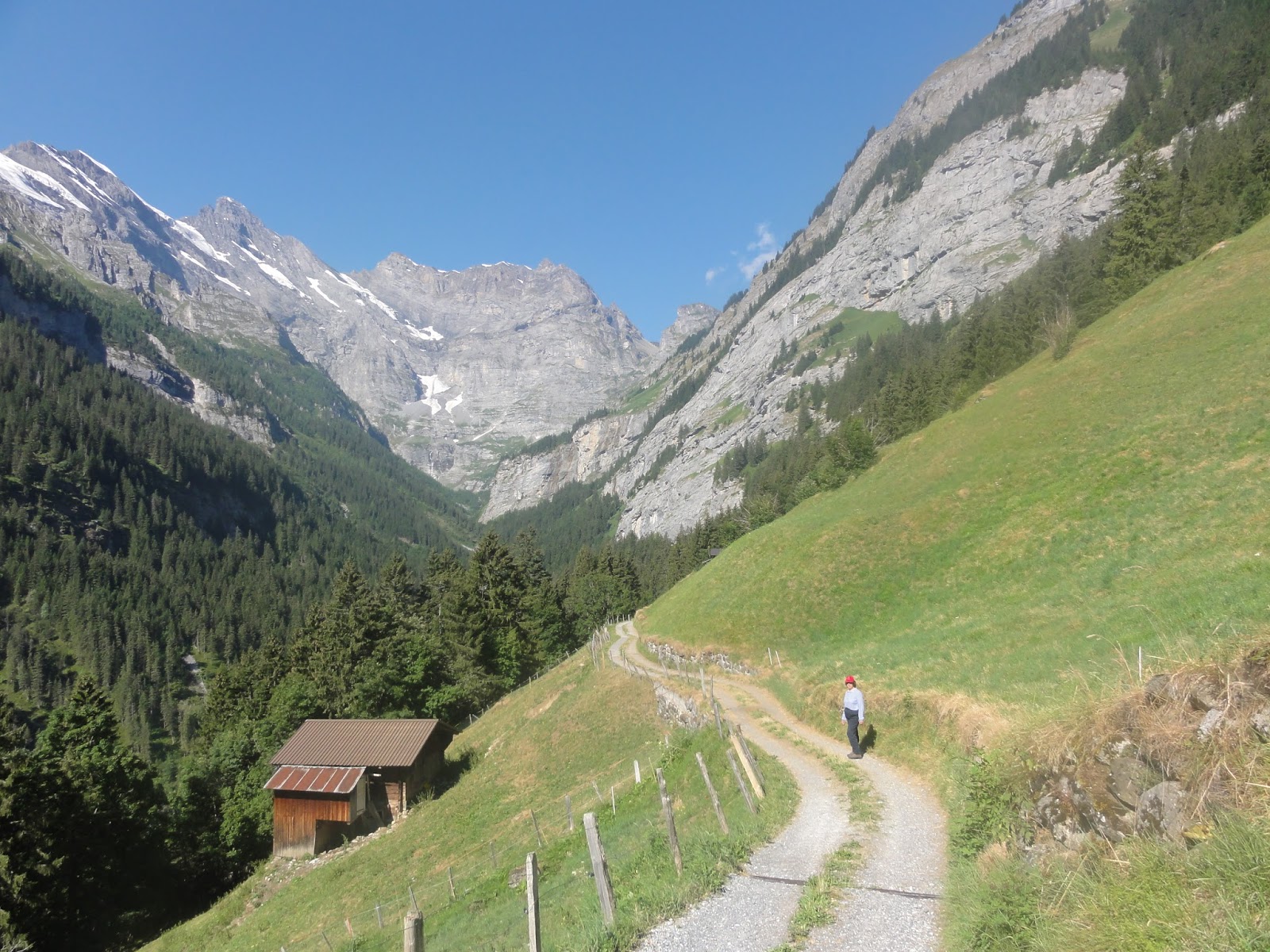
We had considered going up the Schilthorn the next morning, Tuesday, July 21st, and the weather was beautiful,but we had done that several times before, and it's very expensive. Instead, after the buffet breakfast at the Pension, we tried a trail that was new to us: from Gimmelwald up the valley of the Sefinen creek to a meadow, surrounded by rock walls, called the Kilchbalm--or Chilchbalm.
Either spelling was used on the signage and in the guidebook materials. Rick Steves says that it is an easy hike, two hours out, and then back over the same route, with an increase in altitude of only 800 feet. This is misleading. There is a net increase of 800 feet: 450 feet down, followed by 1250 feet up, in some places fairly steep. At one point near the end there is a very short but steep climb on loose gravel. The last hour of the hour-and-a-half outward hike is, in some places, like climbing a series of stairs. Much of the walk is through a pine forest. Eventually, the view back down the valley becomes a panorama of the standard local threesome, Ogre, Monk and Maiden.

We were on a fairly tight schedule, since we needed to catch a train at Interlaken Ost at 3:04 and therefore should catch the 12:30 cable car down to Stechelberg. Given the uphillness of the trail, we felt that we were going more slowly than the signage-predicted hour-and-a-half. Our turn-back time of 10:30 was fast approaching, and we came to the conclusion that it was unlikely that we would get to the Kilchbalm soon enough. We reached a bench and rested. I was in favor of turning around immediately, but Mary Joy wanted to go on a little farther, even though we couldn't see anything other than more pine trees. Shortly after starting out, she met an elderly woman coming, alone, from the other direction. This woman assured her that the Kilchbalm was only five or ten minutes farther. So we went on, and we're glad that we did, not so much because the place was spectacular (it was nice but not overwhelming--on the scenery scale not quite up to the level of Crater Lake, at the end of the Maroon Bells walk near Aspen, Colorado), but because we would have wondered what we had missed.


The walk back was a little faster, and we got back to Pension Gimmelwald before noon, so we had a quick lunch on the terrace. Then we picked up our luggage and went to the cable car. However, the ticket booth was closed until 2:30, the next cable car was in ten minutes and we didn't have our tickets! I didn't have enough change for the ticket machine, so Mary Joy went back to the Pension to get some. I goofed up my first try at getting tickets out of the machine, but instead of giving me my money back, the machine gave me a printed voucher. When I used the coins Mary Joy had gotten, it gave me our tickets, but another voucher instead of change.

We caught the cable car down, and when I had explained things at the ticket booth there, the man very nicely, instead of merely cashing our vouchers, recalculated our fares to make use of the half-fare cards, printed our bus tickets to Lauterbrunnen and gave us ten francs (a little more than ten dollars) change. By then, however, we had missed the bus, whose schedule is synchronized with the arrival of the cable car. We had to wait half an hour for the next bus. By the time we arrived in Lauterbrunnen, there were less than ten minutes until the train to Interlaken that we needed to catch in order to catch the train to Zug that would get us there at 5:30, as we had told Mary Joy's cousin Eva.

There was a line in the ticket office: two groups ahead of us, and the first one apparently had a complicated issue to deal with. Then another clerk appeared and opened up another line. We were closest to him, and Mary Joy immediately went to him and started to ask for tickets to Zug, although one of the two guys in the group immediately ahead of us in the first line grumbled about it. We picked up our tickets and caught the train to Interlaken Ost, still a little worried that we might not get there in time. However, when the conductor came around, we discovered that we had another problem: our tickets were not from Lauterbrunnen to Zug but from Interlaken Ost to Zug! I had visions of us being tossed of the train in Zweiluetschinen, but, in the end, the conductor allowed us to buy tickets on the spot, for three francs and eighty cents apiece.

We were indeed in time to catch the next train to Lucerne, where we picked up a train to Zug: total time, nearly two-and-a-half hours. Eva was there to greet us and drove us to the apartment she shares with her husband Andreas. That evening, Andreas, as usual, cooked a wonderful dinner, which we shared with them and Eva's sister and brother-in-law, Sylvia and Kurt--a very pleasant evening.

Eva and Sylvia, Albert's daughters, are Mary Joy's third cousins once removed--Mary Joy's great-great-grandfather, Karl, was an older brother of Sylvia and Eva's great-grandfather, Fritz. Karl, you may remember, was somehow involved with the Unterseen Stadthaus, while Fritz became a successful businessman. Their brother Robert went to Wisconsin to make cheese, where he was later joined by Karl's son, also named Robert--Mary Joy's great-grandfather.

Tuesday, August 4, 2015

Gimmelwald and Above

On the morning of Monday, July 20th, we said goodbye to our apartment in Unterseen and headed for the mountains. We have now stayed three times at one of the apartments over Frau Eggimann's shop. It is very comfortable and pleasant, and very well located, while our hostess is very nice. At times it can be a little noisy, as it faces the Bahnhofstrasse, the busiest street in Unterseen, but it's a five-minute walk from the West train station. It is across the street from the Coop supermarket and a few blocks from the Michel bakery.

We took the train from West to Ost, then the train to Lauterbrunnen. The normal way to Gimmelwald is to take the bus up the valley of the White Luetschine from Lauterbrunnen to Stechelberg, then the Schilthornbahn cable car up to its first stop. However, the Rick Steves book suggested, as more scenic, a slightly more roundabout route: go up the cable car from Lauterbrunnen to Gruetschalp, take the train along the rim above the valley, to Muerren, then go down the Schilthornbahn one stop to Gimmelwald. As I presented my ticket to the man at the cable car turnstile, he refused it, saying that the way to Gimmelwald was to take the bus to Stechelberg, but I insisted, pointing to the "VIA MUERREN" on my ticket, so he let us through.

The last time we were on this cable car, I don't know how many years ago, it wasn't a cable car but a funicular. We had gone the opposite direction, taking the train from Muerren to Gruetschalp, then went down the funicular, sharing a car with a group of people with northern English accents, who laughed at us for having watched "Hetty Wainthropp Investigates," a British TV series about a detective in northern England, on PBS. But some years ago, an avalanche wiped out the funicular, so it had been replaced by this cable car.

As we herded int the large car, we were almost bumped up against a woman who looked at Mary Joy and said: "I know you. Aren't you Mary Joy?" Mary Joy immediately recognized her as a fellow organist from the Twin Cities, a former student of our good friend Steve. Steve had played at our wedding, and just a few weeks ago had helped Mary Joy prepare for her recital at Wayzata Community Church, then turned pages and pulled stops for her during the recital itself. This woman, Karen, took a picture of Mary Joy with her phone and said: "I'll send this to Steve right away. He'll bust a gut!" She and her husband had taken a river cruise and were finishing up by visiting Switzerland, and were now, I think, on their way to the Schilthorn. The odds against their choosing this particular route at the exact same time that we were taking this particular way to Gimmelwald must be astronomical. It is, indeed, a small world.

The short train ride was less scenic for us than it might have been, since we were late getting aboard and had to sit on the right side of the train, away from the view across the valley to the Eiger, Moench and Jungfrau. After leaving the train, we walked for what seemed like ages through the elongated village of Muerren, from the train station at its north end to the cable car at its south end. Muerren became a ski resort back in the 1920s, mostly frequented by the British.

We caught the next cable car down to Gimmelwald, and walked up the street to the Pension Gimmelwald.

Gimmelwald is one of Rick Steves's "back doors": theoretically, a small, untouristed place that allows you to get in touch with the real essence of a European country. Sometimes one of his "back doors" is discovered by Europeans and becomes a mainstream tourist center: Steves "found" the Cinque Terre, on the Italian Riviera, and now it's a national park and thronged with hikers and people who just like to hang out in a picturesque Italian coastal town, like Vernazza, that doesn't have a beach and so isn't wall-to-wall with tanning bodies.

Gimmelwald, on the other hand, has not been "discovered"--except by Americans wandering the village streets with their blue-and-orange Rick Steves guidebooks. Every single person that we saw and heard at the Pension Gimmelwald, one of the two restaurants in town, during the three meals that we ate there, was an American.

Gimmelwald is a cute little village, is more authentic than a resort like Muerren or Grindelwald, and it provides a decent base for doing some hikes (though Muerren may be better), but it is not exactly exciting.

The Pension is an old, rustic, three-story building run by a group of young Brits. Most rooms don't have their own bathrooms, but ours, Room 6 on the second floor (third floor, as Americans would count them), is one of the exceptions. The room was comfortable and pleasant. European windows almost never have screens, so you learn to live with an occasional fly or mosquito. The WiFi there wasn't exactly high-bandwidth, but was good enough for e-mail and a little browsing--not for downloading or uploading anything.

After checking in, we decided to have lunch at Almendhubel and come back down to Gimmelwald via the North Face Trail. We took the cable car back to Muerren, then another up to Almendhubel. There is a restaurant there with a good reputation, so that's where we had lunch. I must admit that as I write this, two weeks later, I can't remember what we ate or even whether we liked it.

I will not describe the North Face Trail in detail, since I have done that before--this was the third time that we have walked it.
The trail gets its name from a series of boards along it pointing out all the individual peaks whose north faces were visible, and showing how those north faces were conquered by mountain climbers. It is longer (about two-and-half hours long) than the trail from Maennlichen to Kleine Steidegg and a little more difficult. It starts by going down a little, then gradually up, up, up, then gradually down again, a lot.
Rick Steves got us mixed up at the beginning of the trail the previous time we walked it, and he still hasn't gotten it right in the latest book. Instead of beginning down below Almendhubel, at Sonnenberg, it begins at the end of the Flower Trail, up behind Almendhubel. It then goes down the hill, not even going to Sonnenberg,but passing at a slight distance. Sonnenberg is one of the three farm-restaurants along the route, the others being Suppenalp, where the trail starts going up, and Schiltalp, just after it starts coming down again. An "alp" is a place where farmers stay during the summer to graze cattle in the high mountain meadows. They may also make cheese there--Bergkaese (mountain cheese).

At Schiltalp we bought some cheese, and also some homemade apricot jam.
We tried to take the alternate route down to Gimmelwald, but lost it somehow, trying to avoid the trail that passes behind the Sprutz waterfall--a slippery path--and found ourselves back on the regular North Face Trail, as it came around to Muerren. At this point we met a Scottish family--father, mother, daughter and son--who were resting before taking on what looked to be a rather steep path down to Gimmelwald. In recent years they had spent their vacation in Virginia and Florida, but today they were celebrating the son's twelfth birthday by having taken the cable car up to the Schilthorn, then, because the weather up there wasn't great, taking it back down a little way to Birg, walking all the way down to Almendhubel, then around to here on the North Face Trail! The mother, by the way, had bad knees, so she was using walking sticks! This made us feel old and out of shape, especially since we decided not to go down that steep-looking path with them to Gimmelwald, but to go into Muerren and take the cable car down.

We had dinner on the very scenic terrace at the Pension. They had a menu limited to soup, a pasta-and-meat dish, I forget exactly what, and dessert. I had their house.beer, "Schwartz Moench" ("Black Monk"), named after the huge rock outcrop at the base of the Moench and Jungfrau, immediately across the Lauterbrunnen valley. Not bad.

Monday, August 3, 2015

The Niesenbahn and Spiez

On Sunday, July 19th, after breakfast (our usual Interlaken breakfast of muesli with milk and fruit, orange juice and instant coffee, with half a nussgipfli (a croissant filled with hazelnut paste). Then we went to the station and bought tickets to the Niesen Kulm.

The Niesen (which, oddly, means "Sneeze" in the local dialect) is a prominent mountain in the Interlaken area, but I had never heard of it before. It is the northernmost point of the range that separates the Kander and Simmen valleys. Old (and new) pictures of Unterseen's quaint Old Town show it in the distance,
while it towers over Spiez and the Lake of Thun like a dark pyramid. In fact, the ads for the Niesenbahn funicular call the mountain "the Swiss Pyramid." On the mountain there was a display of copies of artistic representations of the mountain. The painter Paul Klee, himself Swiss, seems to have seen its shape as a sort of mystical abstraction.


We took the train to Spiez, where we boarded a local train in the direction of Brig. The first stop on the line, a few kilometers south of Spiez, is Muelenen, where the train stops only by request. The directions in the train as to how to do this are pretty clear: as soon as the train has left Spiez you can push a button by the door and a green light comes on, then, when the train arrives at Muelenen, it stops and you get off and pass under the tracks and follow the signs to the Niesenbahn.

This is one of the older, slower funiculars around, over a hundred years old, and goes up the mountain in two stages, taking half an hour, running every thirty minutes. In our car was a very gregarious old (at least 80) Swiss man, named Erwin, who cracked everyone up with his imitation of an alphorn and other musical instruments (performing James Bond music, "Caravans," etc.).

At the top, as with all Swiss funiculars, there was a restaurant, where we had lunch on the terrace--again I had bratwurst in onion sauce with roesti--not as good as in Basel.
We walked up to the viewing platform, from which we had a beautiful view, pretty far to the west, east, and north, though there was a little bit of haze.
Along the way were boards telling about the geography, zoology and history of the Niesen. A hotel and restaurant had been built there in the 1850s, when the only way to the top was to walk or be carried up by mule or sedan chair. The building of the funicular in 1910 had no doubt increased the number of visitors.

Looking up the Simmental (the valley of the river Simmen) we couldn't see up to Zweisimmen, where the ancestors of one of Mary Joy's church cantors had come from, or beyond that, not many miles, to Sankt Stefan, where Mary Joy's ancestors had lived before being drawn down to Unterseen for better opportunities.

We went back down to Mulenen (by funicular, not by mule or sedan chair), and since the train back to Spiez ran about every half hour, we took a walk into the tiny, unexciting village and back to the stations. To stop the train, as an illustrated sign pointed out, you would not stand by the tracks and try to wave it down, but would push a button, and the fact that the next train had been notified that you were waiting would be indicated by a red light turning off and a green light turning on.

We had considered going on to Thun by lake ferry, but decided that the schedules wouldn't work out--so instead, we would take the train from Spiez back to Interlaken. This left us with a little time to explore Spiez. It is a very pleasant lake resort, with a small, gardened castle that has art exhibitions.
Walking back to the station from the lakeside was a bit of a climb, and we might have had a little trouble finding our way if we hadn't received a nice, unsolicited offer of help from a couple of local men, who walked with us nearly the whole way.

It started to rain, pretty heavily, while we were on the train. A Chinese woman across from us was taking picture after picture of the lake and the mountains on the other side, through the rain, with her cellphone. The twenty-minute ride from Spiez to Interlaken West is, indeed, the most beautiful short train ride I've ever been on, and gives me a wonderful feeling of homecoming whenever we approach Interlaken for the first time again after a year or years away.

The rain had finished when we met Albert again and walked to dinner at the Cafe de Paris, on the Marktplatz. I don't remember exactly what we had, but it was good, and we spent a pleasant time with Albert.